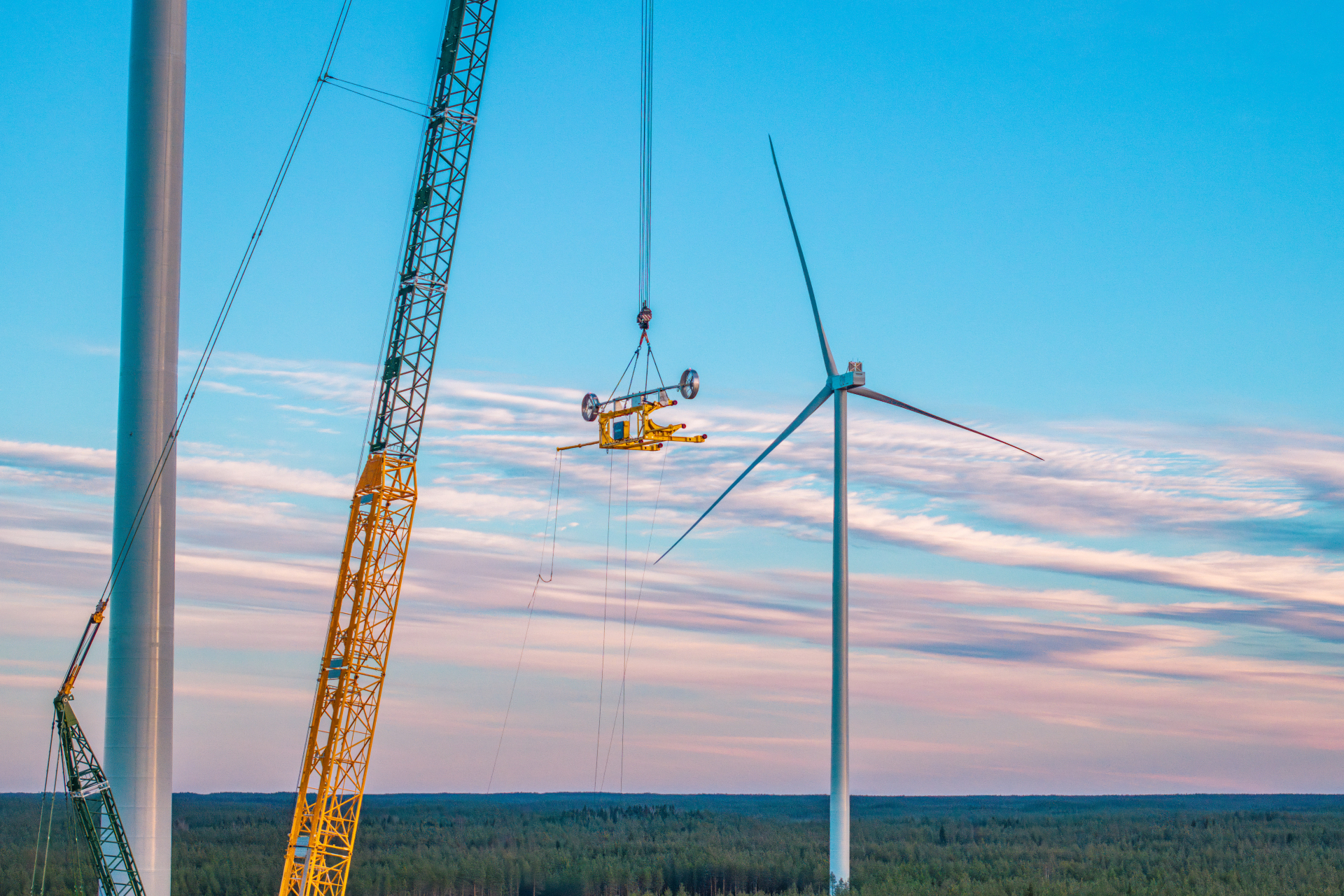
According to the latest project listing by Suomen uusiutuvat, roughly 56 gigawatts (GW) of onshore wind power and nearly 26 gigawatts (GW) of industrial‑scale solar power are currently planned in Finland.
At the beginning of 2026, there are 401 onshore wind power projects in various stages of development, with a combined total of nearly 6,900 turbines. In addition, 306 solar power projects are in development, covering a total area of approximately 30,000 hectares.
Ilmatar among the largest developers and producers
According to the latest statistics from Suomen uusiutuvat ry, Ilmatar is the third‑largest renewable energy project developer in Finland when measured by the combined cumulative capacity of onshore wind and solar projects. Ilmatar has nearly 5,000 megawatts of solar and wind capacity under development and permitting.
In addition to renewable power plants, Ilmatar also has permitted and developing energy storage projects totaling 305 megawatts. Energy storage plays a key role in a functional and flexible energy system, and its importance grows as renewable generation increases.
In line with its strategy, Ilmatar focuses on its most profitable projects and those closest to construction readiness.
The association’s statistics also show that Ilmatar owned the most onshore wind capacity in production at the end of 2025.
“This result stems from several years of determined work to build a diverse and competitive project portfolio,” says Jussi Mäkinen, Director responsible for project development.
Planned energy policy supports project implementation
The number of solar projects has grown rapidly and is already approaching the number of onshore wind projects, which highlights the significant potential of domestic solar power. As solar development accelerates, it becomes increasingly important that regulation supports smooth and sensible project execution.
“In terms of solar energy, Ilmatar has permitted more projects than any other developer in Finland. We now have experience from projects in around 20 municipalities. Based on this experience, the proposed obligation in the Land Use Act revision to zone all solar plants over 50 hectares is not appropriate. Municipalities and regions differ, and the pressures on land use vary. A rigid zoning requirement would increase the burden on municipalities and unnecessarily slow down clean energy projects,” Mäkinen says.
For wind power, a minimum distance of 1,250 metres between turbines and the nearest residences is being proposed. This requirement does not affect Ilmatar’s project portfolio, as corresponding distances have already been taken into account during development, and our significant solar portfolio is already fully permitted.
“The law will bring much‑needed clarity to the investment environment, but it also shows that permitting can still remain tight and slow down new projects. Finland has enormous potential for renewable energy production, and companies are ready to increase electricity generation as soon as investments move forward. We hope that legislation will support this development smoothly and predictably. That benefits everyone,” Mäkinen says.